Guides
Is Forebet Sure? How Reliable Its Predictions Really Are
26 Nov 2026 · SurestFootball
"Is Forebet sure?" Thousands of people ask it every week, usually just before copying a Forebet prediction onto a betting slip. The answers they find online are a single number ("about 50%", "70% on favourites") or a promise ("very sure", "100% sure tips"). None of them helps, and some are simply made up.
This guide answers the question properly. It explains how sure a Forebet prediction can ever be, what its percentages really promise, and the method professionals use to measure how reliable any forecaster is. By the end you will be able to test Forebet's predictions, or ours, or any tipster's, with a spreadsheet and 100 matches, and know whether a good run is skill or luck.
Short answer: No, and nothing in football is. Forebet is a serious, free statistical model and a sensible baseline, but every Forebet prediction is a probability, not a certainty. A 60% prediction is expected to fail four times in ten, and that is the model working as intended. The useful question is not "is it sure?" but "are its percentages honest?": do 60% predictions come true about 60% of the time, does it beat a simple baseline, and does it beat the bookmaker's closing odds? This guide shows you how to check all three.
How sure can a football prediction ever be?
Football is a low-scoring game. One deflection, one red card or one missed penalty can flip a result, so even a strong favourite loses surprisingly often. That is why every serious model, Forebet's included, speaks in percentages instead of promises.
- A 50% prediction is a coin toss with a slight lean. Expect it to fail half the time.
- A 65% prediction fails about one time in three.
- An 80% prediction is strong, yet still fails one time in five, and over 100 such picks you should expect around 20 losers.
"Sure" in football can only ever mean "more likely than the price suggests, repeated over many matches". Anyone who sells a single match as 100% sure is either mistaken or lying.
What Forebet itself claims (and does not claim)
Forebet presents its predictions as the output of a mathematical model built on historical data from more than 850 football leagues since 2009, with no human input. Its FAQ is careful: it describes its predictions as information, and its tool as something to help users, not as a promise of winners. Forebet does not publish an official long-term accuracy figure.
That honesty is a good sign. Be wary of anyone who quotes you a precise "Forebet accuracy" figure without saying which matches, which market, which period and how they counted.
Why a "sure %" or accuracy figure misleads
Imagine two forecasters. One only predicts heavy favourites and is right 75% of the time. The other predicts every match in a league and is right 48% of the time. Who is better? You cannot tell, because they are answering different questions.
Three facts make raw hit rates misleading:
- Most football outcomes are not likely. In a typical league, home wins happen a bit under half the time and roughly a quarter of matches are draws. A Pred that picks the most likely of three outcomes will often be a 40–55% call, so it should be "wrong" close to half the time even if it is perfectly good.
- Hit rate ignores the price. Winning 55% of bets at odds of 1.80 still loses money (break-even at 1.80 is 55.6%). Winning 48% at odds of 2.20 makes about 5.6% profit. Accuracy and profit are different things.
- Short samples lie. A good week or a bad week tells you almost nothing (see the sample-size section below).
The test that matters most: calibration
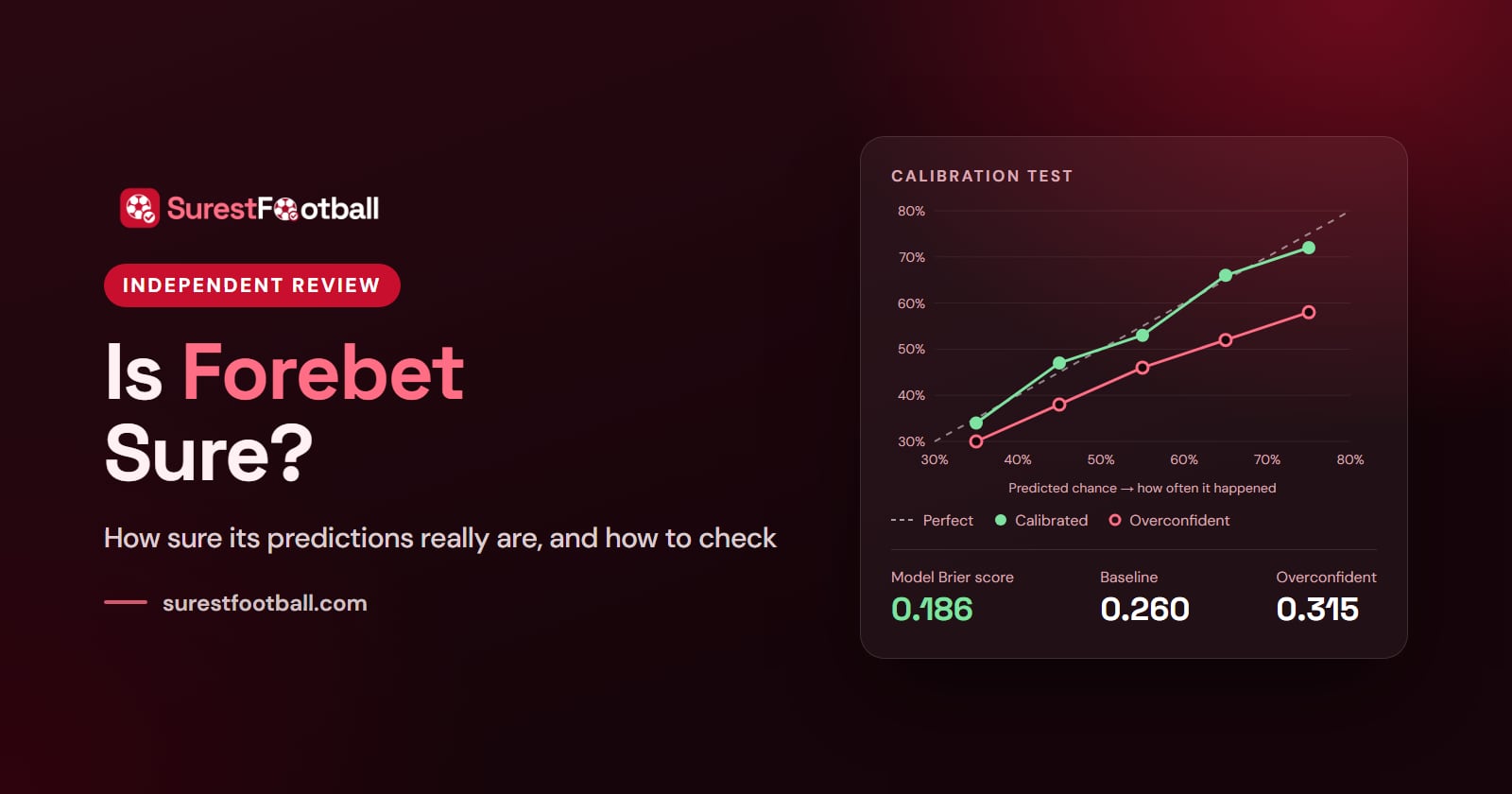
A forecaster is calibrated when its percentages come true as often as it says. Of all the matches it gives a 60% chance, about 60% should happen. Of its 30% calls, about 30%.
To test calibration, group predictions into bands and compare the predicted chance with what actually happened:
| Probability band | What a calibrated model should hit | Warning sign |
|---|---|---|
| 30–40% | about 35% | well under 30% or over 40% across a large sample |
| 40–50% | about 45% | consistently under 40% |
| 50–60% | about 55% | consistently under 50% |
| 60–70% | about 65% | consistently under 60% |
| 70%+ | about 75% or more | "sure" picks landing at 60% |
If a model's 70% calls only land 60% of the time, it is overconfident, and its odds comparisons will make bets look better than they are. If its 40% calls land 50% of the time, it is underconfident on those outcomes. Either way, you now know how to adjust its numbers.
Scoring a forecaster with one number: the Brier score
Calibration needs many matches. A quicker way to compare two forecasters on the same matches is the Brier score, used by weather forecasters and sports modellers alike:
Brier score for one prediction = (probability − outcome)², where outcome is 1 if it happened and 0 if it did not. Average it over all predictions. Lower is better; 0 is perfect.
Here are five home-win forecasts. Forecaster A is a model; forecaster B lazily says 46% for every home side (roughly the home-win base rate).
| Match | Home won? | Model A | A's score | Baseline B |
|---|---|---|---|---|
| 1 | Yes | 70% | (0.70 − 1)² = 0.090 | 46% |
| 2 | No | 55% | (0.55 − 0)² = 0.303 | 46% |
| 3 | No | 35% | 0.122 | 46% |
| 4 | Yes | 62% | 0.144 | 46% |
| 5 | Yes | 48% | 0.270 | 46% |
| Average Brier score | 0.186 | 0.260 | ||
The model beats the baseline (0.186 against 0.260), even though it was "wrong" on match 2. Now add an overconfident forecaster C who says 90% or 10% every time and gets two of the five badly wrong: C scores 0.315, worse than the lazy baseline. Confidence without calibration is punished, which is exactly what you want from a test.
A close cousin, log loss (the average of −ln(probability given to what actually happened)), punishes confident mistakes even harder. On the same five matches: model A 0.560, baseline B 0.712, overconfident C 0.915.
The hardest test: beating the closing odds
The bookmaker's price just before kick-off (the "closing line") already contains almost everything public: form, injuries, line-ups and the money of sharp bettors. That makes it one of the toughest benchmarks a model can face.
To test a model against it, take the closing odds for each prediction, remove the margin (divide each implied probability by their total), and compute the Brier score for the market exactly as you did for the model. If the model's score is consistently lower than the market's over hundreds of matches, it is genuinely adding information. If it is higher, as it is for most public models in the big leagues, the model is still useful as a second opinion, but you should not bet whenever it disagrees with the market.
A practical shortcut is closing line value: if the odds you take are regularly bigger than the closing odds (you took 2.10 and it closed at 1.95), your selections are usually landing on the right side of the information, even before results come in.
How many matches before you can judge? (Sample size)
Results are noisy. The table shows the range in which a forecaster with a true 60% hit rate will land 95% of the time, purely through luck:
| Number of predictions | Likely range of hit rate for a true 60% forecaster |
|---|---|
| 50 | 46% – 74% |
| 100 | 50% – 70% |
| 300 | 55% – 66% |
| 1,000 | 57% – 63% |
(Calculated from the standard error √(p × (1 − p) ÷ n).) So a 70% month on 50 picks proves nothing, and neither does a 48% month. Judge on hundreds of predictions, and always in the same market and probability range.
Run your own Forebet audit: a 100-match method
You do not need to trust anyone's accuracy claim, including ours. Here is a method you can do in a free spreadsheet in about ten minutes a day.
Step 1: Decide the rules before you start
Pick one market (say 1X2), one set of leagues and one rule (for example, every match in the top five leagues, or every Forebet prediction of 55% or more). Write the rule down. Changing it halfway is how people fool themselves.
Step 2: Record the numbers before kick-off
Set up these columns: Date · Match · Market · Forebet probability (%) · Pred · Odds available · Closing odds · Result (1 = happened, 0 = didn't) · Brier term · Notes (team news). Fill in everything except the result before the match starts.
Step 3: Fill in results and score them
After full time, add the result and the Brier term: (probability − result)². Add the same for the market's margin-free probability in a second column.
Step 4: After 100 matches, read four numbers
- Hit rate against the average probability you recorded. If Forebet's average probability was 58% and the hit rate is 57%, it is well calibrated on your sample.
- Calibration by band: split into 40–50%, 50–60%, 60%+ and compare each with what happened.
- Brier score: model versus market. Lower wins.
- Profit at level stakes at the odds you could actually get. This is the number that pays, and the one most affected by luck.
Step 5: Keep going
One hundred matches is the start, not the verdict. Keep the sheet running to 300 and the picture becomes much clearer.
Where football predictions are most and least reliable
Even a good model does not perform evenly. As a general pattern:
- Big, well-covered leagues give the model the most data, but the market is also at its sharpest there, so beating it is hardest.
- Small leagues and early-season rounds give the model little data, so its probabilities carry wider error, but prices can be softer.
- Draws are the hardest outcome to forecast; draw probabilities rarely rise far above 30%.
- Over/under 2.5 and BTTS often sit close to 50/50, so hit rates near 55–60% on these markets are good, not bad.
- Correct score and HT/FT have many possible outcomes, so even the top pick lands rarely. Judge them only on calibration and price, never on hit rate.
Our sister site explains why the model behaves this way, Poisson maths and all, in Forebet Mathematical Prediction: How It Works.
How to read Forebet's green and red colours fairly
Forebet colours finished predictions green when the prediction matched the result and red when it did not. That is a fair record of the Pred letter, but remember what it does not show:
- It grades the letter, not the probability. A green 41% call and a green 80% call look identical.
- It ignores the odds, so it cannot tell you whether following the predictions made or lost money.
- A day can look very green or very red through luck alone (see the sample-size table).
For what every column, colour and tab on Forebet means, see 4CastBet's guide on how to read Forebet predictions.
Red flags: "sure" tips, fake accuracy and "Forebet VIP" scams
Forebet's own "Avoid scam" page warns that many pages and people use its name or copy its content to take money from users, sometimes claiming to be "sponsored by Forebet". Forebet states that its content is free, that it has no paid plans or agents, and that it does not sponsor other pages. Practical red flags for any prediction seller:
- Claims of "100% sure", "fixed" or "guaranteed" matches. There is no such thing.
- Accuracy figures with no list of past predictions you can check.
- Records that only show wins, or that start "from last week".
- Anyone selling access in Forebet's name.
A trustworthy source shows every result, won or lost, permanently, so you can audit it with the method above.
How SurestFootball shows its record
We hold ourselves to the same standard we have just described. Every SurestFootball prediction for today carries its chance and the bookmaker's price, and once a match is over, the result stays on our results page, wins and losses alike. Our VIP ticket has its own permanent VIP results record, so you can judge it before you ever pay for it. How we build our picks is explained on how our predictions work.
Frequently asked questions
Is Forebet sure?
No prediction is sure, and Forebet does not claim otherwise. Its percentages are probabilities: a 60% call should fail about four times in ten. Judge it on whether those percentages come true at the stated rate over hundreds of matches.
Is Forebet accurate?
Forebet is a credible statistical model and a reasonable baseline, but there is no independent, official accuracy figure for it. Test it yourself on 100–300 matches using calibration, the Brier score and a comparison with closing odds.
What is Forebet's success rate?
Forebet does not publish one. Any single "success rate" depends on the market and the probability range chosen. For 1X2 predictions, which are often 40–55% calls, a hit rate around half is normal for a sound model.
Why do "sure" Forebet predictions still fail?
Because most of them are not likely events. A prediction with a 45% chance should fail 55% of the time. Judge the model on whether its percentages come true at the stated rate, not on single matches.
Which Forebet market is most accurate?
Markets with two outcomes (over/under, BTTS, double chance) naturally show higher hit rates than three-outcome 1X2 or many-outcome correct score. That does not make them more profitable; price decides that.
How many predictions do I need to judge a tipster?
At least 100 in the same market, and preferably 300 or more. With 50 predictions, a true 60% forecaster can easily show anything from about 46% to 74%.
Is Forebet better than the bookmakers?
Closing odds are one of the hardest benchmarks in football forecasting. Treat Forebet as a second opinion; where it strongly disagrees with the market, check team news before trusting it. We compare the methods in detail in Forebet vs bookmaker odds, Elo, xG and tipsters.
Is "Forebet VIP" real?
No. Forebet states that it has no VIP groups, paid predictions or subscriptions, and warns users about scammers using its name.
The full Forebet series
- Forebet Mathematical Prediction: How It Works & How to Use It (Sportiya): the Poisson model, a full worked example and the margin-free value method.
- How to Read Forebet Predictions (4CastBet): every column, tab and colour, plus a glossary.
- Forebet vs Bookmaker Odds, Elo, xG and Tipsters (FootballFuse): which prediction method suits which job.
Forebet's own warning about impersonators is on its Avoid scam page.
Betting involves risk. Predictions are for information only and are never guaranteed. Please read our responsible gambling page and only bet if you are 18 or over and it is legal where you live. SurestFootball is not affiliated with Forebet.